I Trust AI More Than I Should, and It Scares Me.
AI and human connection, and what we might lose along the way
Both are true, and I’ve stopped pretending they aren’t.
I’m excited by AI. I use it, and I like what it does. It explains things when I don’t understand, helps me prepare for difficult conversations and finds words when I can’t quite find them myself.
Here’s the part I’m less proud of: it never judges me. I can ask it a question I’d be embarrassed to ask a colleague, and it answers calmly. It helps me sort through my thoughts. Sometimes, I come away feeling more prepared, even a little smarter than when I started.
Honestly, who wouldn’t keep going back to something that helpful?
But something still doesn’t quite add up.
Trust between people takes time. It’s built through difficult conversations, disappointments and the moments when someone shows up for you, even when it’s not convenient. We learn to trust people because, time and again, they show us that they care. Yet I hand my doubts to a machine within seconds. I know it’s a machine, and still, I trust it. Perhaps that’s part of the appeal. There’s no awkwardness, no fear of being judged, and no worrying about taking up someone’s time.
But there’s a difference. A machine can give me comforting words. It can’t care about me the way another person can.
But I’m not a celebrity
At AI and Big Data Expo recently in Amsterdam , I attended Marinela Profi‘s session, Why the Leaders Who Win the Agentic AI Race Won’t Be the Ones Who Move Fastest.
She spoke about why we’re increasingly turning to AI when we feel uncertain or vulnerable. I recognised something of myself in what she was saying.
Afterwards, I asked her for a photograph for my blog.
“But I’m not a celebrity,” she said, smiling.
I smiled, too. I wanted the photograph because her words had made me stop and reflect. Not because she was a celebrity.
It was a small moment, but one I wanted to remember.
What do we learn when we work things out for ourselves?
Working in Learning & Development has taught me that some of my most valuable lessons came from conversations that went wrong, mistakes I made, and situations I had to navigate without knowing how they would turn out.
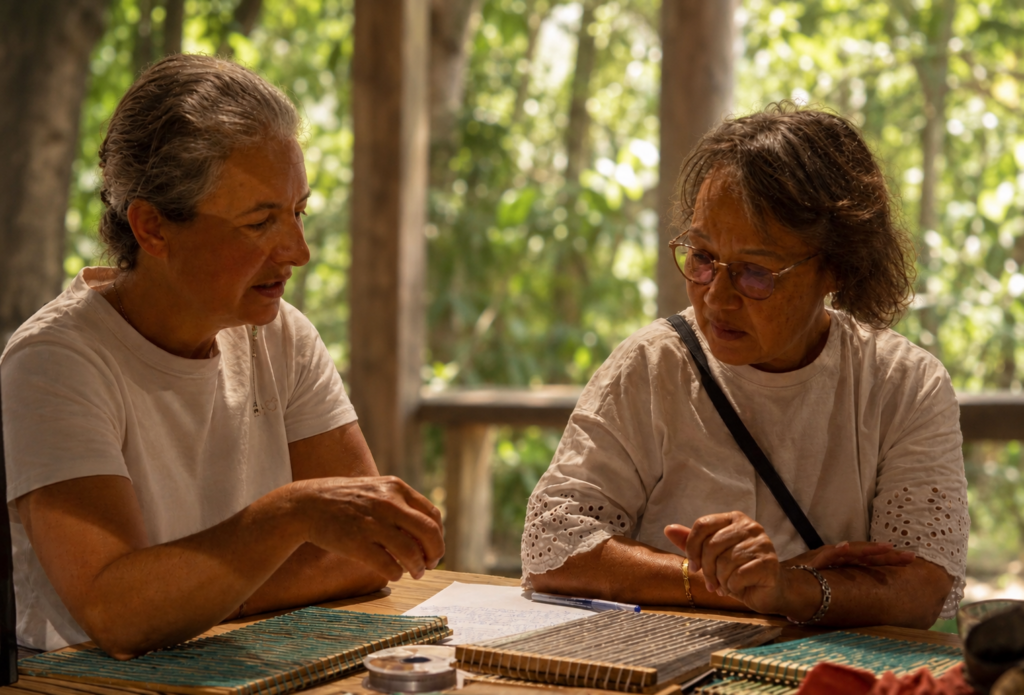
AI can help me prepare. It can offer different perspectives and help me find the words. But when the conversation actually happens, I still have to listen, respond and work out what to do next.
Knowing what to do in theory is one thing. Working it out when you’re actually in that situation is another.
Some of the things I’ve learnt most from weren’t planned lessons. They came from getting things wrong, having to rethink my approach and figuring things out along the way.
I wouldn’t want to lose those experiences simply because finding an answer has become easier.
What will the next generation learn?
My generation remembers life before AI became part of everyday life. We have something to compare it with.
The next generation may not. Turning to AI first could feel as natural to them as searching the internet feels to us.
I don’t see that as a bad thing. They’ll have opportunities we never had, and I’m excited about that. But I do wonder what they’ll learn along the way, and what they might miss if every question is met with an immediate answer.
At home, I can share something with my child and hear, “What’s the research behind that?”
Fair enough. We look it up.
But sometimes the evidence isn’t conclusive. And then the response can be, “Well, if there’s no proof, there’s no point believing it.”
That makes me pause.
I want my child to question things, look for evidence and challenge what they’re told. But I also want them to understand that not every question has a clear-cut answer. Sometimes, we have to sit with uncertainty, consider different perspectives and make up our minds without having all the answers.
I don’t have a simple answer for how we teach that. Perhaps it starts with allowing ourselves to do the same.
I know AI will continue to change how we think, learn and find answers. I’m excited about that. But I hope we never lose sight of the value of human connection, of learning from one another and of the experiences that shape who we become.
Because, in the end, technology may change how we live, but meaning will still rest with people.